3M™ Night Vision Series is a reflective window film that gives you daytime privacy while letting natural light in. From outside, the glass looks reflective during the day, so passers-by see less of your room, while its low interior reflectivity keeps your view out clearer at night than a standard mirror film. This privacy window film also rejects solar heat, reduces glare and blocks 99.9% of UV rays, according to 3M™ performance data, which makes it a practical privacy film for windows in Singapore homes and offices facing busy streets or neighbouring blocks. We supply it as Singapore’s authorised 3M™ distributor, and our 3M™ certified team installs it.
Every roll we install is sourced directly from 3M™ and covered by official 3M™ warranty. For Night Vision Series, the warranty covers peeling, bubbling, blistering, delamination and discolouration, for up to 10 years on fixed and sliding windows and 3 years on casement (swing) windows. You can register your installation on our warranty and support page.
Night Vision Series is most useful where daytime privacy matters as much as heat and glare control.
Homeowners often choose Night Vision Series for ground-floor and low-floor units, flats facing a neighbouring block, and landed homes with large street-facing windows. It lets you keep curtains open during the day without giving up privacy. At Gem Residences, the Managing Agent approved NV35 for residents’ windows.
In offices and shophouses, Night Vision Series can help reduce screen glare and stop people outside from seeing into work areas during business hours, while lowering the solar heat that reaches the air-conditioning. In a 3M™ case study at Embarcadero Center in San Francisco, a 345,000 sq ft installation of Night Vision 25 reported a payback period of under one year. Savings in any building depend on its glass, orientation and usage.
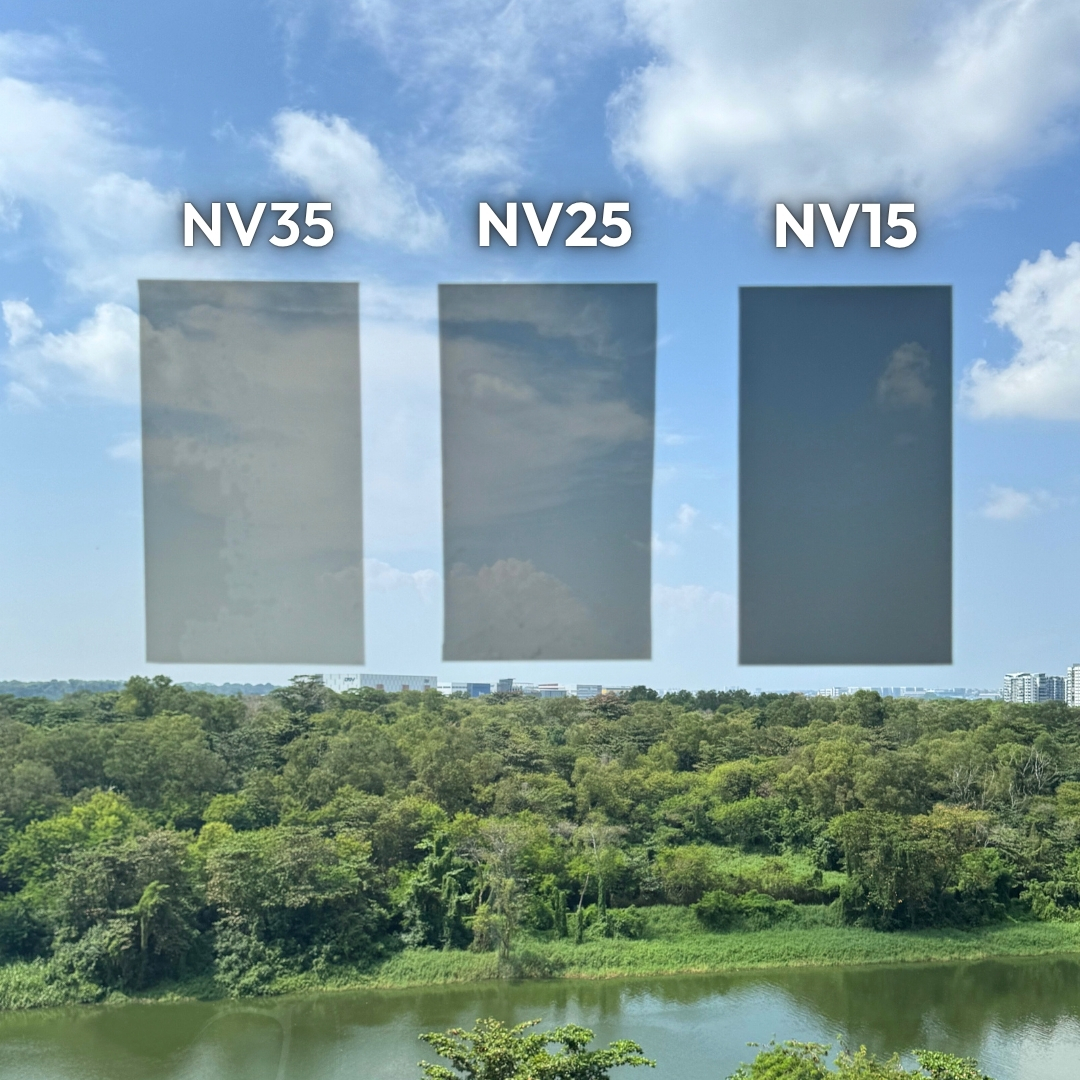
Night Vision Series comes in three shades. The number roughly reflects how much light the film lets through, so NV15 is the darkest and most private and NV35 is the lightest. All three block 99.9% of UV rays. Figures below are 3M™ data for film on 6 mm clear single glass, and results on tinted or double-glazed glass differ.
| Shade | Visible light transmitted | Total solar energy rejected | Glare reduction |
|---|---|---|---|
| NV15 | 13% | 72% | 85% |
| NV25 | 24% | 63% | 73% |
| NV35 | 33% | 54% | 63% |
Here is what Night Vision Series is designed to do once it is on your glass.
If you are deciding between the two, the main question is privacy. Night Vision Series looks reflective from outside and gives daytime privacy, while 3M™ Prestige Series stays clear and almost invisible, so it suits homes that want heat rejection without changing how the windows look. We cover the differences in our Prestige vs Night Vision comparison, and you can explore other privacy film for windows if you need privacy at night.
Browse performance data, product guides, and case studies for homes, retail, and more.
Feedback from customers who had 3M™ film installed by our team.
Questions we are often asked about 3M™ Night Vision Series before installation.
Install it after major works such as hacking and drilling are done, and before curtains, blinds or grilles go up. A clean, dust-free site lowers the chance of dust being trapped under the film.
We would recommend to install our 3M Night Vision Window Films only after all major renovation works are completed (e.g. hacking and drilling) and before any installation of curtains, blinds or grilles. This is because the condition of the site must be as clean and dust free as possible so as to minimise the chances of dirt trapped bubbles on the window film.
Night Vision Films and other 3M solar films help to address three issues that we face in Singapore, mainly heat, glare and harmful ultraviolet (UV) rays. For example, if your room faces the hot afternoon sun or if you have severe glare concerns, we propose that you apply our 3M films for improved home comfort. If you want to keep your furniture looking new for longer, 3M films can filter at least 99% of the UV radiation that cause it to fade quickly.
A floor plan does not show exact window sizes, so we cannot quote from it. WhatsApp our consultants photos of your windows with their measurements for an estimate, or book an onsite consultation and we will measure every panel.
Within the Night Vision Series, yes. On the same glass, NV15 rejects more solar energy than NV35. Across different series or brands, a darker film is not always better, so compare films with a similar light level. Our Solar Film Comparison catalogue shows the figures side by side.
Curtains and blinds sit inside the room, so much of the sun’s heat has already passed through the glass by the time it reaches them. Night Vision film works at the glass itself and also protects curtains and blinds from UV fading. Many homes use both.
Not on its own. Night Vision Series gives daytime privacy because it is brighter outside than inside. At night, when your lights are on, people outside may be able to see in, so pair it with curtains, blinds or a frosted film in rooms that need privacy after dark. Its low interior reflectivity means you see less of your own reflection at night than with a standard mirror film.
Start with how private and how bright you want the room to be. NV15 is the darkest and gives the strongest daytime privacy, which suits street-level rooms. NV35 keeps rooms brighter and is often chosen for higher floors where privacy matters less. We bring all three shades to the site visit so you can compare them on your own glass.
Visible Light Transmission (VLT) refers to the percentage of visible light that passes through the film. For example, our 3M Prestige PR40 film allows 40% of light to pass through, while our PR70 film allows 70% of light to pass through. You can get a good idea of the film’s VLT simply by looking at how darkly tinted the film is.
Total Solar Energy Rejected (TSER) is a statistic that quantifies the total amount of solar energy that is stopped from flowing through the window (UV light + visible light + infrared rays). When comparing heat rejection performance amongst film brands, consider the Total Solar Energy Rejected statistic as well as the Infrared Rejected metric.
No, films with a high TSER are not always better performers because they may be significantly darker or extremely reflecting, which may be undesirable. As a result, looking at films with the same visual light transmission (VLT) before evaluating their TSER performance is a better way to analyze the film’s performance.
Do not clean the windows for the first 30 days while the film cures. After that, use water with a soft cloth or a clean synthetic sponge, with separate cloths for the inside and outside of the glass. Avoid newspaper, paper towels, bristle brushes, abrasive cleaners and heavy pressure.
We have films that allow more visible light to pass through while giving excellent heat reduction, such as the lighter shades of our 3M Prestige Series (e.g. PR60 and PR70). They do not change the outlook of the window much and you would hardly notice it is even there at all!
We can submit film samples to your MA for approval. Our 3M™ films have been approved at major condominium developments.
Browse performance data, product guides, and case studies for homes, retail, and more.
Premium 3M™ solutions with exclusive discounts.
WhatsApp us